The betrayal misunderstanding
The light house: A love storyThe betrayal misunderstanding is the decisive rupture between Blake McGrath and Connie Dixon before their relationship is restored. Hearing Connie promise Duncan Cartwright that she will get “the painting” and “all” of them, Blake assumes that their intimacy has been an elaborate scheme to acquire his canvases. His interpretation turns love into evidence of manipulation; Connie’s explanation then reveals that the real danger lies in her unresolved past with Duncan, not in any plot against Blake. The episode converts a private telephone call into a confrontation over art, bodily exploitation, grief, trust, and the necessity of speaking truths that both lovers have withheld.
The Trigger in the Studio
Blake has just completed Connie’s portrait, a work rendered with dedication and extraordinary detail, and has signed it with a flourish, intending to show it to her the following morning. The timing makes the overheard call especially destructive: he is still carrying the emotional investment of having translated Connie’s face, longing, and sadness into a painting when he hears her speaking harshly and secretly on the telephone. From the hallway he sees her hunched over the kitchen table, cupping the phone in her hand and staring blankly at the wall before her voice becomes strident. Her promise to Duncan that she will obtain the painting and get them all sounds, in isolation, like a confession of calculated intent.
Blake’s response is immediate and physical. His expression becomes one of betrayal, his heart seems to drop, and the surroundings begin to whirl. When he enters the kitchen, his eyes are dark and dead, his face filled with loathing. He tells Connie that she has played him for a fool, then returns toward the studio, converting the room where he made her portrait into the setting for an accusation. The studio therefore holds two incompatible versions of their relationship at once: it contains Blake’s loving artistic attention and, in his first interpretation of the call, the supposed proof that this love has been exploited.
Accusation and Collapse
Blake insists that Connie wanted his paintings and had manipulated him to obtain the canvases. His disbelief is directed as much at himself as at her; he reproaches himself for having been gullible and for failing to recognize the scheme earlier. In a gesture of contemptuous surrender, he tells her to take the paintings, then empties his jeans pockets and throws the few loose coins onto the floor as though every material possession in the room has been reduced to the same degraded currency. The paintings, his money, and his affection are momentarily treated as interchangeable things Connie might seize.
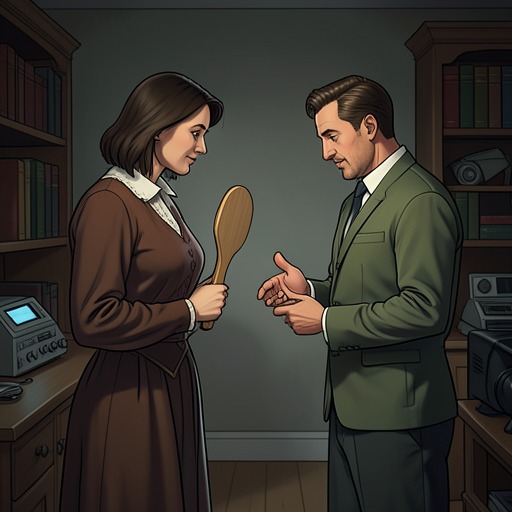
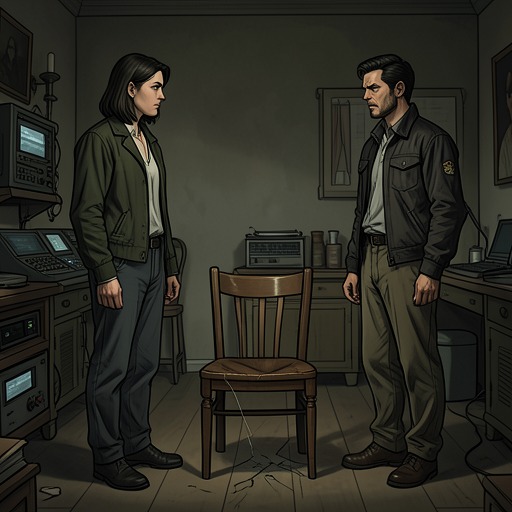
Connie tries to reach him, calling his name and pressing herself against his chest while sobbing that he does not understand. Blake holds her away, orders her to take the paintings and leave his house and his life, and grips her shoulders so tightly that red marks appear on her arms. His rage is inseparable from injury: he believes he has offered the most vulnerable parts of himself to someone who was merely performing attachment for access to his art. When he says that he heard what she said about their relationship and about what she had to endure to obtain the paintings, the misunderstanding becomes cruelly persuasive because it fuses two separate histories—Connie’s forced sexual past with Duncan and her voluntary intimacy with Blake.
The scene’s emotional force comes from this collision of partial knowledge. Blake has heard the words but not their circumstances; Connie possesses the circumstances but has concealed them. His interpretation is therefore not an invented suspicion detached from the evidence, but an emotionally charged conclusion drawn from a deliberately incomplete truth. The phone, ordinarily a means of connection, becomes the object that exposes how little the lovers know about each other’s lives. Connie’s attempt to explain is initially rejected because Blake is responding not only to the present call but also to the older catastrophe of betrayal and loss that has governed his isolation.
Connie’s Hidden Past
Connie finally identifies the caller as Duncan Cartwright, her former boss at the gallery where she worked. She explains that Duncan had used her sexually for four years. After leaving home and moving to New York because she wanted to become an artist, she had no money and was dependent on Duncan’s support. He recognized her talent and encouraged her to continue painting, but he paid her bills until she was indebted to him and then demanded repayment through sex. Her account reframes the apparent calculation of the telephone conversation: Connie has not been using Blake to secure his work, but has been trying to escape a coercive arrangement that shaped her adult life and damaged her ability to speak about it.
Connie also clarifies the material point that provoked Blake’s suspicion. She had given Duncan one of her own paintings for his birthday two years earlier, and the works mentioned on the call were her old pieces still stored at the gallery. Duncan wanted them removed and threatened to burn them. The threatened destruction is significant because Connie’s paintings represent the artistic life she pursued before Duncan’s exploitation interrupted it. Her attempt to retrieve them is an act of self-protection and recovery, not an effort to possess Blake’s hidden canvases.
The clarification of the sexual reference is equally important. Duncan had taunted Connie by asking whether she missed him and recalling the sex and the behavior he had demanded in bed. Her harsh dismissal of that past—she explains that she acted only to survive and was revolted each time—shows why the call sounded incriminating while actually recording her rejection of the man who controlled her. The misunderstanding thus rests on a cruel distortion: Blake mistakes a survivor’s guarded, compressed conversation about coercion for the language of a lover’s conspiracy.
Recognition and Reconciliation
When Connie’s explanation reaches Blake, his certainty breaks. He closes his eyes and feels relief wash over him because she has not betrayed him; the repeated realization that she has not betrayed him marks the emotional reversal of the episode. His voice loses its earlier sting, and he asks why she did not tell him. The question does not erase the violence of the confrontation, but it changes its governing emotion from contempt to wounded recognition. Blake understands that Connie withheld the truth even while he had shared the tragedy of Chloe’s death with her, and Connie acknowledges that she should have offered him the same honesty.
The reconciliation turns on Connie’s direct statement that she does not want the paintings and only wants Blake. She takes one tentative step toward him, then another, while Blake’s own feet carry him toward her before he consciously decides to move. They meet in the middle of the studio and cling to each other like survivors of a disaster that nearly destroyed their lives. The movement matters because the scene has been organized around forced distance—Blake holding Connie away, ordering her out, and turning from her toward the window—yet reconciliation is expressed through involuntary movement back into physical closeness.
That night, they make love while the wounds of the confrontation are still fresh. Their intimacy is presented not as a simple return to previous desire but as an effort to reconnect and heal after both have exposed painful truths. Touch becomes a form of rediscovery, restoring the bond that the misunderstanding had nearly severed. The episode therefore makes reconciliation conditional on disclosure: physical union follows only after Connie names Duncan’s exploitation and Blake recognizes that the evidence he trusted was incomplete.
Context of Grief and Trust
The misunderstanding gains additional weight from Blake’s ongoing mourning for Chloe. His nightly beach ritual with Ned, sending a rose into the sea at sunset and leaving the dog to wait on the empty beach until sunrise, shows that grief has structured his life through repetition. The ritual preserves his bond with his drowned daughter, but it also keeps him oriented toward loss. Connie’s presence begins to draw him back toward ordinary life: after she shares the pain surrounding Chloe’s death, he dusts Chloe’s bedroom and changes the sheets, sensing that his former self is beginning to emerge even though the sorrow will never disappear.
That movement toward recovery makes Blake especially vulnerable to the possibility of another betrayal. He has begun to allow Connie into the private spaces formed by grief, including the studio and the memories attached to his art. The overheard call threatens to prove that this opening has been fatal. Yet the same relationship that triggers the crisis also provides the testimony through which it can be survived. Connie’s confession gives Blake a fuller account of her life, while his willingness to accept it prevents his grief from turning permanently into suspicion.
The consequences extend beyond the immediate embrace. Blake later tells Connie that going blind seemed to end his artistic career, but that he painted her portrait because he wanted redemption; at the opening of the Connie Dixon Gallery of Fine Art, he announces that he will return to the easel and paint emotion rather than seascapes or portraits. The reconciliation therefore belongs to a larger transformation. Connie is not merely cleared of an accusation: her insistence on truth helps Blake move from the closed loop of Chloe’s memorial ritual toward love, public life, and renewed art. The betrayal misunderstanding becomes the crisis through which both characters confront the histories they had hidden and begin, painfully, to imagine a future not governed entirely by what was lost.